



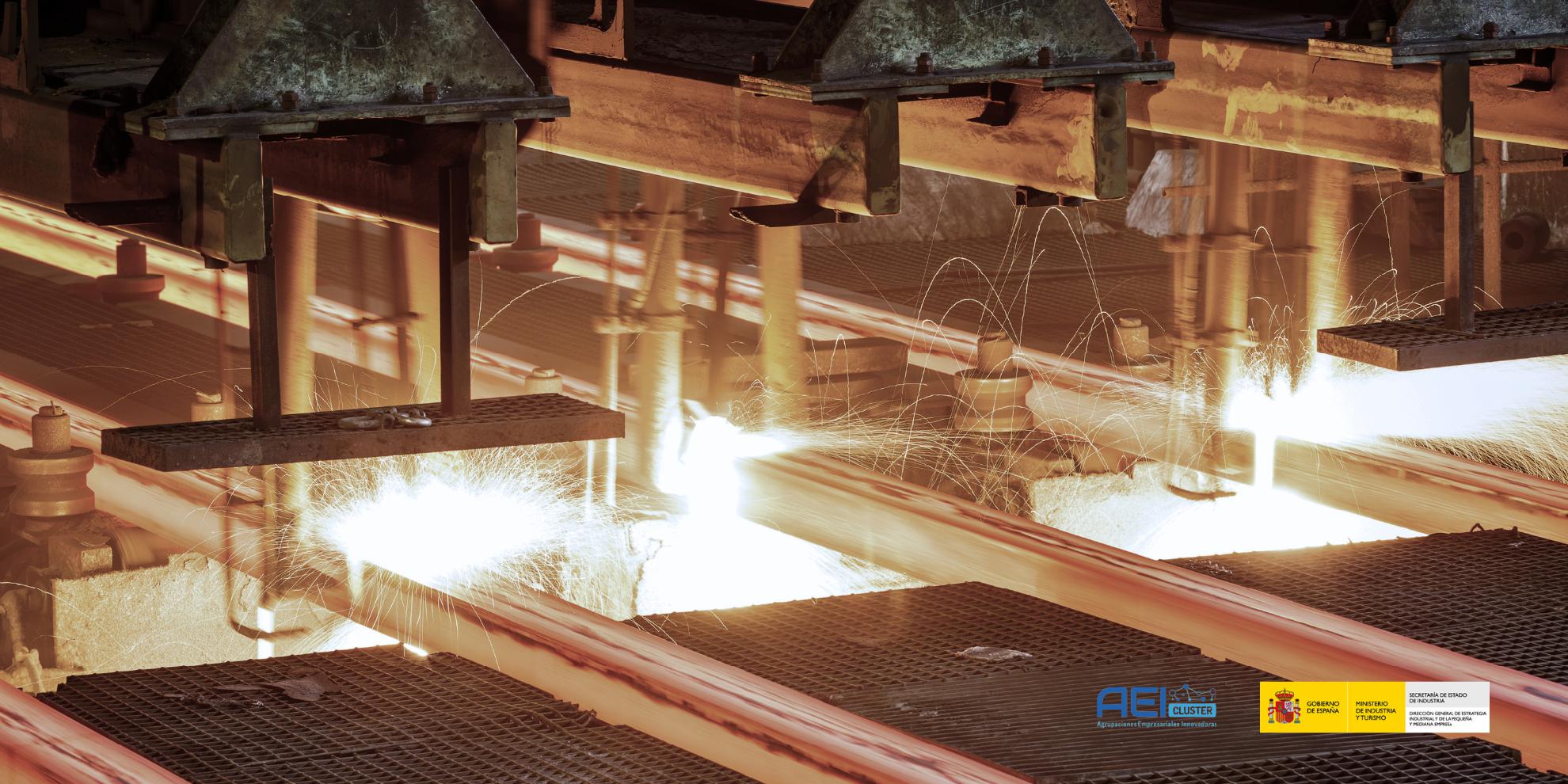
Drought is no longer an exceptional situation. In Catalonia and a large part of the Mediterranean basin, water scarcity has become one of the main challenges for industrial competitiveness and economic sustainability. The restrictions of recent years have highlighted the need to transform the way industry manages this resource, especially in water-intensive sectors such as the steel industry.
In this context, BLUESTEEL was born, an innovation project that explores how digital technologies can contribute to smarter, more efficient and safer industrial water management.
The steel industry is a strategic sector for the European economy and for the transition to a low-carbon economy. But it also depends on an increasingly limited resource: water. This resource is essential for processes such as equipment cooling or product quality control, so any limitation in its availability can directly affect production and the competitiveness of companies.
The sector's figures illustrate this dependence. According to data from the World Steel Association, steel production captures on average about 28 m³ of water per tonne. However, the net consumption is between 1.6 and 3.3 m³ per tonne, as around 90% of the water is returned to the environment or reused after the cooling and cleaning processes. The electric arc furnace route (EAF), the technology used by CELSA, is the most efficient in the use of water, with a net consumption approximately half that of the integral route (BF-BOF). In this context, CELSA is among the most efficient companies in the sector, with a specific consumption of only 0.84 m³ of water per tonne of billet in 2024 and a system of closed circuits of cooling that allows water to be recirculated continuously.
Added to this challenge are new regulatory requirements, the need to reduce consumption, guarantee water quality, prevent health risks and protect increasingly connected infrastructures. For this reason, efficient water management has become a strategic element for the future of the industry.
BLUESTEEL has developed and validated a new management model based on the advanced digitalization of the industrial water cycle. The initiative combines smart sensing, real-time monitoring, artificial intelligence, data analytics and digital twins to gain a global view of water systems and anticipate potential incidents before they become a problem.
This approach allows us to evolve towards more predictive management, improving decision-making and optimizing available resources.
The project has culminated with the pilot implementation of the solution in an industrial plant of CELSA, one of the main steel companies in Europe, validating in a real environment the potential of digitalization applied to water management.
The platform developed makes it possible to monitor 9 critical systems of the water circuit and integrate 40 operational variables, including their historization, improving the control, traceability and global vision of the plant's different water circuits. This facilitates the early detection of deviations, leaks and overconsumption, the optimization of water reuse and recirculation processes, and a faster response to possible operational or health incidents. Specifically, it has been possible to relate water consumption to production, giving visibility to variations according to the type of product and quality. When the system has been in operation for a year, it is expected to be able to detect patterns and reduce the water consumption of products with anomalous results, as well as reducing detection and response times to incidents.
The project has also incorporated advanced tools for water quality control, through biosensors, IoT sensors and predictive analysis capabilities. In this area, probes or control points have been deployed in critical systems such as cooling towers and domestic hot water circuits, achieving an expected reduction of at least 20% in the predictive risk index of legionellosis.
In addition, a decision support system (DSS) has been developed that integrates 5 main data sources — historical data, IoT sensors, SCADA, PLCs and analytical systems — and provides real-time information to optimize water resources management. At the same time, the project has incorporated a secure, interoperable and scalable digital architecture, based on Unified Namespace (UNS), reinforced with industrial cybersecurity protection and control measures to guarantee the integrity, confidentiality and availability of systems and data.
BLUESTEEL is a collaborative innovation project funded by the Ministry of Industry and Tourism within the framework of the support programme for Innovative Business Groups (AEI).
The initiative is coordinated by the Catalan Water Partnership (CWP) and has the participation of the Cluster Digital, CELSA Group, SPIN, ULBIOS Techsens and Aquater, combining expertise in water management, industrial digitalization, biosensing and cybersecurity.
BLUESTEEL lays the foundations for a replicable model with potential for application to other plants in the CELSA group and to other water-intensive sectors, such as chemicals, food or energy.
"In a context of climate change and scarcity of water resources, optimization is key. BLUESTEEL has shown that digital technologies can become a key tool to move towards a more efficient, resilient and sustainable industry", highlight the CELSA Environment team.
For his part, Xavier Amores, director of the CWP, stresses that "at the CWP we opted to create a group of users of the water resource a few years ago and that, during the drought, took on more prominence, and with which we have promoted projects in the water vector. This project is a good example of the collaboration with CELSA and its sustainability and innovation department to promote innovative actions in the water cycle of industrial processes. We think that cases like this are also an excellent example of the work that many Catalan industries are doing to save water, and we hope that it can be extrapolated to many other industrial sectors".
On the other hand, Joan Puaté, manager of the Cluster Digital, points out that "projects like this show the value of collaboration between industry, technology companies and clusters to develop innovative solutions with a real impact on competitiveness and industrial sustainability".
Beyond the technical results, BLUESTEEL demonstrates that digitalization can become a decisive tool to face the challenges associated with sustainable water management, an increasingly strategic resource for the future of the industry.


