



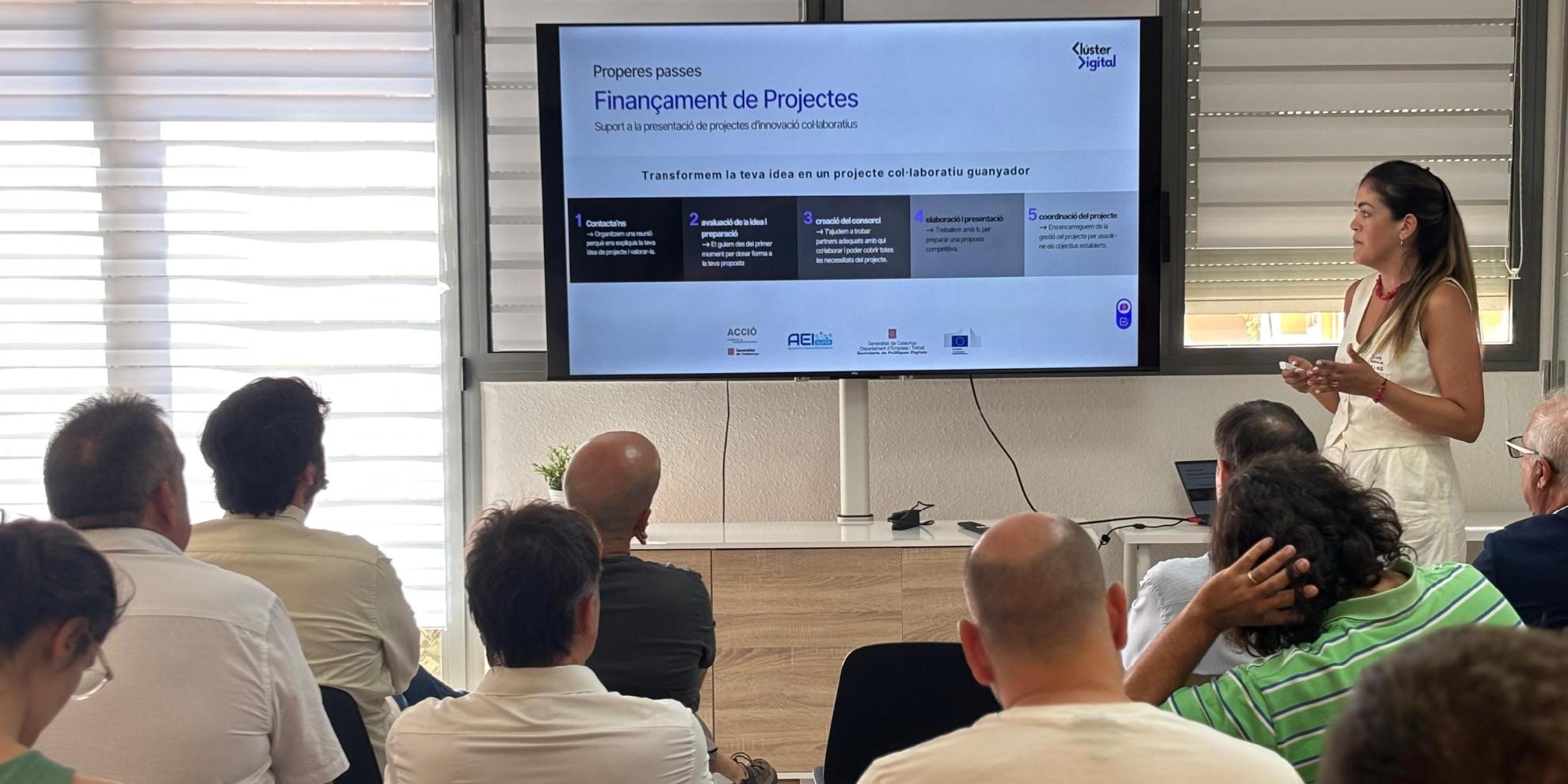
On June 30, the Clúster Digital de Catalunya organized the session "Grants, financing and opportunities for technology companies" that brought together about thirty professionals interested in learning about the main financing tools to promote R+D+i projects and accelerate the growth of their organizations.
The conference offered a practical vision of the path that an innovation project follows: from the definition of an idea to the identification of the most appropriate financial support channels, combining public, European and private resources.
The conference began with an institutional welcome by Joan Puaté, manager of the Cluster Digital, who highlighted the role of the Cluster as a promoter of collaborative innovation projects, supporting companies in identifying calls, building consortia and attracting competitive funding.
Next, Yeimy Ospina, head of European and innovation projects at the Cluster Digital, explained how to transform an idea into an innovation project with real funding options. During his speech, he presented the Cluster's accompaniment methodology, which covers the entire process, from the initial validation of the idea to the construction of consortia, the preparation of competitive proposals and the management of approved projects.
He also highlighted the results achieved: between 2023 and 2025, the Cluster has contributed to attracting more than €5.2 million in grants, with 49 project proposals submitted, 33 projects funded – a 67% success rate – and the participation of 45 companies. In addition, he shared examples of projects promoted by the cluster, funded by the Generalitat de Catalunya, the State and the European Commission, which demonstrate how collaboration between companies, knowledge centres and other agents in the ecosystem makes it possible to turn business challenges into R+D+i initiatives with impact.
Next, Daniel Contreras, Business Development DIGICTUR at Eurecat, delved into the role of technology centers as strategic partners of innovation. He explained how Eurecat supports companies in all phases of technological development, and highlighted the centre's multidisciplinary approach, which integrates areas such as artificial intelligence, cybersecurity, robotics, cyber-physical systems, health technologies and sustainability to respond to the industry's major challenges. Finally, he stressed that innovation must be an instrument to strengthen the technological autonomy, competitiveness and resilience of companies.
The session continued with the intervention of Emilio Iglesias, head of the CDTI area, who presented the main public instruments to support business innovation. He explained that the CDTI has a wide range of tools adapted to the different levels of technological maturity of the projects (TRL), combining subsidies, partially reimbursable aid, venture capital and other support mechanisms so that each company can find the most suitable one. He also shared some data on the impact of the CDTI during 2025, with nearly 1,500 projects funded, a contribution of more than 1,000 million euros and a clear commitment to SMEs, which represent 65% of the projects financed.
For her part, Macarena Sanz, founder and director of IDConsortium (a consulting firm that collaborates with the Cluster Digital specialising in European projects) focused her speech on the opportunities offered by European R+D+i programmes. He presented the main available calls – such as Horizon Europe, Eurostars, Digital Europe, LIFE, Interreg and the Single Market Programme – and explained which type of project best fits into each one. In addition, he highlighted the criteria that European evaluators usually assess, such as strategic alignment, the degree of innovation, the impact on the market, the quality of the consortium and the plan for exploiting the results.
Finally, Álvaro Berbís, founding partner of Adastra Capital, presented private financing alternatives for innovative companies, focusing on the Tax Equity model. He explained how tax deductions derived from R+D+i activities can become a source of liquidity thanks to the entry of private investors, thus facilitating the financing of new projects without resorting exclusively to debt or subsidies. His speech also contextualised this instrument within the strategy to promote business innovation promoted by the State and highlighted its potential to strengthen the competitiveness of technology companies.
The event, which also included a networking space among attendees, is held annually as an opportunity for companies to learn about the innovation support services offered by the Cluster Digital, resolve doubts with experts and establish new connections that could lead to future collaborative R+D+i projects.


